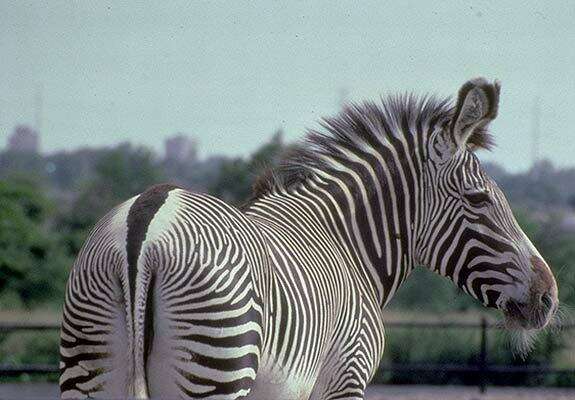
Equus grevyi Oustalet, 1882
Grevy's zebra
Species recognized by The Integrated Taxonomic Information System
, T Orrell (custodian) in
Table of Contents
-
-
-
-
-
-
-
-
-
-
-
-
-
-
-
-
-
-
-
-
-
-
-
-
-
- Add New Content
Overview
Biology
Source and Additional Information
Grevy's zebra has a much more open society than those of other equid species and associations between individuals, other than between a mother and her foal, rarely last for more than a few months (4). Within a single population around ten percent of the mature stallions will occupy territories from which they have sole access to receptive females, although other males are still tolerated within the area (2). These territories are patrolled and marked with dung and are the largest of any living herbivore, at up to 10km2 (2). Temporary groups of between six to twenty zebras also form and may be either single sex or mixed. Mares become sexually mature at three to four years and give birth to a single foal after a gestation period of 13 months every couple of years (2). Foals are able to stand after a mere six minutes and can run after 45 minutes (6), they remain dependent on their mother's milk until six to eight months of age (2). Grevy's zebras are predominately grazers, feeding on a variety of grasses, although they will also browse on trees and scrubs (4). Several theories exist as to the function of zebra stripes, from camouflage to the dazzling of predators. Recent research has suggested however, that they may serve a social function and may stimulate grooming (5). It is believed that the equine ancestor of horses, asses and zebras was striped, but these have subsequently been lost during the evolution of the other two groups (5).
"Equus grevyi Oustalet, 1882". Encyclopedia of Life, available from "http://www.eol.org/pages/129473". Accessed
21 Mar 2010.
Retrieving comments, please wait...


Retrieving comments, please wait...
Loading curation controls, please wait...