<?xml version="1.0" encoding="UTF-8"?>
<taxon-page>
  <id type="integer">1038700</id>
  <canonical-form>Dolichotis patagonum</canonical-form>
  <iucn-conservation-status>Near Threatened (NT)</iucn-conservation-status>
  <scientific-name>&lt;i&gt;Dolichotis patagonum&lt;/i&gt; (Zimmermann, 1780)</scientific-name>
  <common-names>
    <item>
      <language_label></language_label>
      <string>Patagonian Cavy</string>
    </item>
    <item>
      <language_label></language_label>
      <string>Patagonian Mara</string>
    </item>
    <item>
      <language_label>br</language_label>
      <string>Mara Patagonia</string>
    </item>
    <item>
      <language_label>de</language_label>
      <string>Gro&#223;er Pampashase</string>
    </item>
    <item>
      <language_label>en</language_label>
      <string>Liebre Patag&#243;nica</string>
    </item>
    <item>
      <language_label>en</language_label>
      <string>Patagonian Cavy</string>
    </item>
    <item>
      <language_label>en</language_label>
      <string>Patagonian hare</string>
    </item>
    <item>
      <language_label>en</language_label>
      <string>Patagonian Mara</string>
    </item>
    <item>
      <language_label>es</language_label>
      <string>Mara o liebre patag&#243;nica</string>
    </item>
    <item>
      <language_label>es</language_label>
      <string>Mara Pata&#243;nica</string>
    </item>
    <item>
      <language_label>fr</language_label>
      <string>Mara (animal)</string>
    </item>
    <item>
      <language_label>nl</language_label>
      <string>Mara (zoogdier)</string>
    </item>
    <item>
      <language_label>pl</language_label>
      <string>Mara patago&#324;ska</string>
    </item>
  </common-names>
  <taxa>
    <refs type="array">
      <ref>
        <full-reference>Burton, John A. 1987. The Collins Guide to the Rare Mammals of the World. The Stephan Greene Press. Pg. 126.</full-reference>
        <id type="integer">5734</id>
        <published type="integer">1</published>
        <ref-id type="NilClass">5734</ref-id>
        <taxon-id type="NilClass">325011</taxon-id>
        <user-submitted type="boolean">false</user-submitted>
        <visibility-id type="integer">1</visibility-id>
      </ref>
      <ref>
        <full-reference>MacDonald, Dr. David. 1984. The Encyclopedia of Mammals. Equinox (Oxford), Ltd. Pgs. 694-695.</full-reference>
        <id type="integer">5735</id>
        <published type="integer">1</published>
        <ref-id type="NilClass">5735</ref-id>
        <taxon-id type="NilClass">325011</taxon-id>
        <user-submitted type="boolean">false</user-submitted>
        <visibility-id type="integer">1</visibility-id>
      </ref>
      <ref>
        <full-reference>Nowak, Ronald M. 1991. Walker's Mammals of the World, 5th ed. The Johns Hopkins University Press. Pgs. 913-914.</full-reference>
        <id type="integer">5736</id>
        <published type="integer">1</published>
        <ref-id type="NilClass">5736</ref-id>
        <taxon-id type="NilClass">325011</taxon-id>
        <user-submitted type="boolean">false</user-submitted>
        <visibility-id type="integer">1</visibility-id>
      </ref>
      <ref>
        <full-reference>Parker, Sybil P. [Editor]. 1990. Grzimek's Encyclopedia of Mammals, Vol 3. Pgs. 335-336.</full-reference>
        <id type="integer">5737</id>
        <published type="integer">1</published>
        <ref-id type="NilClass">5737</ref-id>
        <taxon-id type="NilClass">325011</taxon-id>
        <user-submitted type="boolean">false</user-submitted>
        <visibility-id type="integer">1</visibility-id>
      </ref>
    </refs>
    <refs type="array">
      <ref>
        <full-reference>Burton, John A. 1987. The Collins Guide to the Rare Mammals of the World. The Stephan Greene Press. Pg. 126.</full-reference>
        <id type="integer">5734</id>
        <published type="integer">1</published>
        <ref-id type="NilClass">5734</ref-id>
        <taxon-id type="NilClass">1074758</taxon-id>
        <user-submitted type="boolean">false</user-submitted>
        <visibility-id type="integer">1</visibility-id>
      </ref>
      <ref>
        <full-reference>MacDonald, Dr. David. 1984. The Encyclopedia of Mammals. Equinox (Oxford), Ltd. Pgs. 694-695.</full-reference>
        <id type="integer">5735</id>
        <published type="integer">1</published>
        <ref-id type="NilClass">5735</ref-id>
        <taxon-id type="NilClass">1074758</taxon-id>
        <user-submitted type="boolean">false</user-submitted>
        <visibility-id type="integer">1</visibility-id>
      </ref>
      <ref>
        <full-reference>Nowak, Ronald M. 1991. Walker's Mammals of the World, 5th ed. The Johns Hopkins University Press. Pgs. 913-914.</full-reference>
        <id type="integer">5736</id>
        <published type="integer">1</published>
        <ref-id type="NilClass">5736</ref-id>
        <taxon-id type="NilClass">1074758</taxon-id>
        <user-submitted type="boolean">false</user-submitted>
        <visibility-id type="integer">1</visibility-id>
      </ref>
      <ref>
        <full-reference>Parker, Sybil P. [Editor]. 1990. Grzimek's Encyclopedia of Mammals, Vol 3. Pgs. 335-336.</full-reference>
        <id type="integer">5737</id>
        <published type="integer">1</published>
        <ref-id type="NilClass">5737</ref-id>
        <taxon-id type="NilClass">1074758</taxon-id>
        <user-submitted type="boolean">false</user-submitted>
        <visibility-id type="integer">1</visibility-id>
      </ref>
    </refs>
    <refs type="array">
      <ref>
        <full-reference>Burton, John A. 1987. The Collins Guide to the Rare Mammals of the World. The Stephan Greene Press. Pg. 126.</full-reference>
        <id type="integer">5734</id>
        <published type="integer">1</published>
        <ref-id type="NilClass">5734</ref-id>
        <taxon-id type="NilClass">1138596</taxon-id>
        <user-submitted type="boolean">false</user-submitted>
        <visibility-id type="integer">1</visibility-id>
      </ref>
      <ref>
        <full-reference>MacDonald, Dr. David. 1984. The Encyclopedia of Mammals. Equinox (Oxford), Ltd. Pgs. 694-695.</full-reference>
        <id type="integer">5735</id>
        <published type="integer">1</published>
        <ref-id type="NilClass">5735</ref-id>
        <taxon-id type="NilClass">1138596</taxon-id>
        <user-submitted type="boolean">false</user-submitted>
        <visibility-id type="integer">1</visibility-id>
      </ref>
      <ref>
        <full-reference>Nowak, Ronald M. 1991. Walker's Mammals of the World, 5th ed. The Johns Hopkins University Press. Pgs. 913-914.</full-reference>
        <id type="integer">5736</id>
        <published type="integer">1</published>
        <ref-id type="NilClass">5736</ref-id>
        <taxon-id type="NilClass">1138596</taxon-id>
        <user-submitted type="boolean">false</user-submitted>
        <visibility-id type="integer">1</visibility-id>
      </ref>
      <ref>
        <full-reference>Parker, Sybil P. [Editor]. 1990. Grzimek's Encyclopedia of Mammals, Vol 3. Pgs. 335-336.</full-reference>
        <id type="integer">5737</id>
        <published type="integer">1</published>
        <ref-id type="NilClass">5737</ref-id>
        <taxon-id type="NilClass">1138596</taxon-id>
        <user-submitted type="boolean">false</user-submitted>
        <visibility-id type="integer">1</visibility-id>
      </ref>
    </refs>
    <nil-classes type="array"/>
    <nil-classes type="array"/>
    <nil-classes type="array"/>
    <nil-classes type="array"/>
    <nil-classes type="array"/>
    <nil-classes type="array"/>
    <nil-classes type="array"/>
    <nil-classes type="array"/>
    <refs type="array">
      <ref>
        <full-reference>1. IUCN Red List  (September, 2008) &lt;a href=&quot;http://www.iucnredlist.org&quot;&gt;http://www.iucnredlist.org&lt;/a&gt;</full-reference>
        <id type="integer">686534</id>
        <published type="integer">1</published>
        <ref-id type="NilClass">686534</ref-id>
        <taxon-id type="NilClass">1420094</taxon-id>
        <user-submitted type="boolean">false</user-submitted>
        <visibility-id type="integer">1</visibility-id>
      </ref>
      <ref>
        <full-reference>2. Nowak, R.M. (1999) &lt;i&gt;Walker's Mammals of the World&lt;/i&gt;. Johns Hopkins University Press, Baltimore, Maryland.</full-reference>
        <id type="integer">690040</id>
        <published type="integer">1</published>
        <ref-id type="NilClass">690040</ref-id>
        <taxon-id type="NilClass">1420094</taxon-id>
        <user-submitted type="boolean">false</user-submitted>
        <visibility-id type="integer">1</visibility-id>
      </ref>
      <ref>
        <full-reference>3. Macdonald, D. (2001) &lt;i&gt;The New Encyclopedia of Mammals&lt;/i&gt;. Oxford University Press, Oxford.</full-reference>
        <id type="integer">690225</id>
        <published type="integer">1</published>
        <ref-id type="NilClass">690225</ref-id>
        <taxon-id type="NilClass">1420094</taxon-id>
        <user-submitted type="boolean">false</user-submitted>
        <visibility-id type="integer">1</visibility-id>
      </ref>
      <ref>
        <full-reference>4. World Database on Protected Areas  (April, 2009) &lt;a href=&quot;http://www.wdpa.org&quot;&gt;http://www.wdpa.org&lt;/a&gt;</full-reference>
        <id type="integer">690947</id>
        <published type="integer">1</published>
        <ref-id type="NilClass">690947</ref-id>
        <taxon-id type="NilClass">1420094</taxon-id>
        <user-submitted type="boolean">false</user-submitted>
        <visibility-id type="integer">1</visibility-id>
      </ref>
    </refs>
    <refs type="array">
      <ref>
        <full-reference>Richard Weigl (2005) Longevity of Mammals in Captivity; from the Living Collections of the World. Kleine Senckenberg-Reihe 48: Stuttgart.</full-reference>
        <id type="integer">730924</id>
        <published type="integer">1</published>
        <ref-id type="NilClass">730924</ref-id>
        <taxon-id type="NilClass">2391929</taxon-id>
        <user-submitted type="boolean">false</user-submitted>
        <visibility-id type="integer">1</visibility-id>
      </ref>
    </refs>
    <nil-classes type="array"/>
    <nil-classes type="array"/>
    <nil-classes type="array"/>
    <nil-classes type="array"/>
    <nil-classes type="array"/>
    <nil-classes type="array"/>
    <nil-classes type="array"/>
  </taxa>
  <overview>
    <data-objects type="array">
      <data-object>
        <bibliographic-citation></bibliographic-citation>
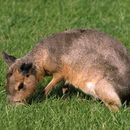
        <description>In keeping with its strange appearance, the Patagonian mara displays behavioural traits that are very unusual among the rodents. Active during the day, this species spends long periods basking in the sun, either resting on its haunches or with its front limbs folded under its body like a cat. It remains vigilant for predators, however, and when threatened, may escape by galloping or stotting, a high-speed form of locomotion involving rapid bounces using all four limbs at once. Surprisingly, this diminutive species can reach speeds of 45 kilometres per hour over distances in excess of one kilometre. The Patagonian mara consumes a variety of vegetation, usually feeding in grass or shrubland during the day and sheltering in an abandoned burrow of another species, or amongst dense vegetation at night (2).&lt;/p&gt;&lt;p&gt;Perhaps the most unusual feature of this species is its social and reproductive behaviour. Patagonian maras are strictly monogamous (a rare trait in mammals), forming lifelong pairs that generally avoid contact with conspecifics, except during the curious arrangements that form in the austral summer breeding season. The female Patagonian maras dig burrows, in which the young are often reared communally (2) (3). After a gestation period of 90 days (3), the female gives birth to a litter, usually of two young, close to the entrance of a burrow (1) (2). The young, which are born well-developed, with eyes already open, quickly move into the burrow, which may be co-habited by the offspring of several other breeding pairs (2). The young remain in the vicinity of the burrow for the next four months, where they are visited daily by the mother to be suckled. When the breeding pair visits the burrow, the female makes a shrill call, which brings all the infant Patagonian maras in the burrow to the surface. The female then attempts to discern its own offspring within the group by smell, while chasing off the young of other pairs, which try to, and occasionally succeed, in obtaining the female's milk. Once identified, the female leads its offspring a short distance away from the burrow to be fed, while the adult male keeps watch, chasing off other pairs that approach. The other breeding pairs must therefore wait until the preceding pair have departed, before visiting the burrow. This communal behaviour is thought to help reduce predation, as it means that adults are more frequently present around the burrow (3).</description>
        <guid>b28b406a6d70edadb7c063bb2c5b1578</guid>
        <id type="integer">2606574</id>
        <rights-holder>Wildscreen</rights-holder>
        <rights-statement>Copyright Wildscreen 2003-2008</rights-statement>
        <data-supplier-agent>ARKive</data-supplier-agent>
        <tags-hash></tags-hash>
        <attributions>
          <attribution>
            <role>Copyright</role>
            <agent>
              <acronym nil="true"></acronym>
              <display-name>Copyright Wildscreen 2003-2008. Some rights reserved</display-name>
              <homepage>http://creativecommons.org/licenses/by-nc-sa/3.0/</homepage>
              <username nil="true"></username>
            </agent>
          </attribution>
          <attribution>
            <role>Supplier</role>
            <agent>
              <acronym></acronym>
              <display-name>ARKive</display-name>
              <homepage>http://www.arkive.org/</homepage>
              <id type="integer">5978</id>
              <username>arkive</username>
            </agent>
          </attribution>
          <attribution>
            <role>Location</role>
            <agent>
              <acronym nil="true"></acronym>
              <display-name></display-name>
              <homepage nil="true"></homepage>
              <username nil="true"></username>
            </agent>
          </attribution>
          <attribution>
            <role>Source URL</role>
            <agent>
              <acronym nil="true"></acronym>
              <display-name>View original data object</display-name>
              <homepage>http://www.arkive.org/patagonian-mara/dolichotis-patagonum/</homepage>
              <username nil="true"></username>
            </agent>
          </attribution>
          <attribution>
            <role>Citation</role>
            <agent>
              <acronym nil="true"></acronym>
              <display-name></display-name>
              <homepage nil="true"></homepage>
              <username nil="true"></username>
            </agent>
          </attribution>
        </attributions>
        <language>English</language>
        <license>cc-by-nc-sa 3.0</license>
        <type>Text</type>
        <url>http://content2.eol.org/content_large.jpg</url>
        <medium_thumb_url>http://content3.eol.org/content_medium.jpg</medium_thumb_url>
        <small_thumb_url>http://content4.eol.org/content_small.jpg</small_thumb_url>
      </data-object>
    </data-objects>
    <nil-classes type="array"/>
  </overview>
  <table-of-contents>
    <item>
      <id>1</id>
      <label>Overview</label>
    </item>
    <item>
      <id>3</id>
      <label>Description</label>
    </item>
    <item>
      <id>290</id>
      <label>General Description</label>
    </item>
    <item>
      <id>302</id>
      <label>Nucleotide Sequences</label>
    </item>
    <item>
      <id>267</id>
      <label>Morphology</label>
    </item>
    <item>
      <id>232</id>
      <label>Reproduction and Life History</label>
    </item>
    <item>
      <id>70</id>
      <label>Behavior</label>
    </item>
    <item>
      <id>4</id>
      <label>Ecology and Distribution</label>
    </item>
    <item>
      <id>20</id>
      <label>Distribution</label>
    </item>
    <item>
      <id>41</id>
      <label>Habitat</label>
    </item>
    <item>
      <id>297</id>
      <label>Trophic Strategy</label>
    </item>
    <item>
      <id>8</id>
      <label>Conservation</label>
    </item>
    <item>
      <id>33</id>
      <label>Trends and Threats</label>
    </item>
    <item>
      <id>286</id>
      <label>Conservation Status</label>
    </item>
    <item>
      <id>6</id>
      <label>Relevance</label>
    </item>
    <item>
      <id>251</id>
      <label>Uses</label>
    </item>
    <item>
      <id>295</id>
      <label>Procedures</label>
    </item>
    <item>
      <id>300</id>
      <label>Wikipedia</label>
    </item>
    <item>
      <id>9</id>
      <label>Biodiversity Heritage Library</label>
    </item>
    <item>
      <id>7</id>
      <label>References and More Information</label>
    </item>
    <item>
      <id>17</id>
      <label>Literature References</label>
    </item>
    <item>
      <id>226</id>
      <label>Specialist Projects</label>
    </item>
    <item>
      <id>298</id>
      <label>Biomedical Terms</label>
    </item>
    <item>
      <id>227</id>
      <label>Search the Web</label>
    </item>
    <item>
      <id>13</id>
      <label>Common Names</label>
    </item>
  </table-of-contents>
  <ancestors>
    <taxon-page>
      <id type="integer">1</id>
      <canonical-form>Animalia</canonical-form>
      <iucn-conservation-status>NOT EVALUATED</iucn-conservation-status>
      <scientific-name>Animalia</scientific-name>
    </taxon-page>
    <taxon-page>
      <id type="integer">694</id>
      <canonical-form>Chordata</canonical-form>
      <iucn-conservation-status>NOT EVALUATED</iucn-conservation-status>
      <scientific-name>Chordata</scientific-name>
    </taxon-page>
    <taxon-page>
      <id type="integer">1642</id>
      <canonical-form>Mammalia</canonical-form>
      <iucn-conservation-status>NOT EVALUATED</iucn-conservation-status>
      <scientific-name>Mammalia</scientific-name>
    </taxon-page>
    <taxon-page>
      <id type="integer">8677</id>
      <canonical-form>Rodentia</canonical-form>
      <iucn-conservation-status>NOT EVALUATED</iucn-conservation-status>
      <scientific-name>Rodentia</scientific-name>
    </taxon-page>
    <taxon-page>
      <id type="integer">8685</id>
      <canonical-form>Caviidae</canonical-form>
      <iucn-conservation-status>NOT EVALUATED</iucn-conservation-status>
      <scientific-name>Caviidae</scientific-name>
    </taxon-page>
    <taxon-page>
      <id type="integer">103517</id>
      <canonical-form>Dolichotis</canonical-form>
      <iucn-conservation-status>NOT EVALUATED</iucn-conservation-status>
      <scientific-name>Dolichotis</scientific-name>
    </taxon-page>
    <taxon-page>
      <id type="integer">1038700</id>
      <canonical-form>Dolichotis patagonum</canonical-form>
      <iucn-conservation-status>Near Threatened (NT)</iucn-conservation-status>
      <scientific-name>&lt;i&gt;Dolichotis patagonum&lt;/i&gt; (Zimmermann, 1780)</scientific-name>
    </taxon-page>
  </ancestors>
  <children>
  </children>
  <curators>
    <user>
      <credentials>Portland State University, MA Education

</credentials>
      <id type="integer">7</id>
      <username>klans</username>
    </user>
    <user>
      <credentials>BA Physics - Johns Hopkins University
MS Education - Johns Hopkins University
ME Engineering Physics - University of Virginia


</credentials>
      <id type="integer">10</id>
      <username>peter</username>
    </user>
    <user>
      <credentials>Ph.D., University of Bristol (1976)
D.Sc., Queen's University, Belfast (1990)
</credentials>
      <id type="integer">11</id>
      <username>paddy</username>
    </user>
    <user>
      <credentials>developer</credentials>
      <id type="integer">13</id>
      <username>pleary</username>
    </user>
    <user>
      <credentials></credentials>
      <id type="integer">11793</id>
      <username>wilsond</username>
    </user>
    <user>
      <credentials>Asst. Project Manager, Antarctic Invertebrates, Smithsonian Institution
Visiting Scientist, Chemicals Affecting Insect Behavior Lab, US Agricultural Research Service, 2005-2006
Hammock, J., Vinyard, B., Dickens, J. 2007. Response to host plant odors and aggregation pheromone by larvae of the Colorado potato beetle on a servosphere.  Arthropod-Plant Interactions, 1(1):27-35
PhD, Biological Oceanography, Massachussetts Institute of Technology/Woods Hole Oceangraphic Institution, 2005</credentials>
      <id type="integer">20470</id>
      <username>jhammock</username>
    </user>
    <user>
      <credentials>University of Michigan, PhD 1997
Thesis: Social behavior and vocal communication of American Crows (Corvus brachyrhynchos)

Member of Ecological Society of America, Entomological Society of America.</credentials>
      <id type="integer">25567</id>
      <username>csparr</username>
    </user>
    <user>
      <credentials></credentials>
      <id type="integer">33422</id>
      <username>mstuder</username>
    </user>
    <user>
      <credentials>Curator of Zoology (Fishes), Field Museum of Natural History</credentials>
      <id type="integer">34360</id>
      <username>mwestneat</username>
    </user>
    <user>
      <credentials>EOL Species Pages Coordinator, Ph. D. in Entomology, University of Arizona 1999, Diploma in Biology, Freie Universit&#228;t Berlin 1989</credentials>
      <id type="integer">35200</id>
      <username>Katja</username>
    </user>
    <user>
      <credentials>William Miller, PhD
Assistant Professor
Baker University
Dept. of Biology
PO Box 65
Baldwin city, Kansas 
66006-0065


</credentials>
      <id type="integer">35243</id>
      <username>WMiller</username>
    </user>
    <user>
      <credentials>University of California Berkeley
</credentials>
      <id type="integer">35508</id>
      <username>tuco</username>
    </user>
    <user>
      <credentials>Graduate (PhD)student at University of Brasilia, Bras&#237;lia, DF, Brasil and visiting researcher at UMSL, Saint Louis - MO. 
Member of Society of Mammalogy
</credentials>
      <id type="integer">36124</id>
      <username>raquelribeiro</username>
    </user>
    <user>
      <credentials></credentials>
      <id type="integer">36197</id>
      <username>MarthaTestuser</username>
    </user>
    <user>
      <credentials>B.A. Zoology, M.S. Embryology/physiology
college faculty for 44 years
member HAPS (Human Anatomy and Physiology Society)</credentials>
      <id type="integer">36558</id>
      <username>judyjunkyard</username>
    </user>
    <user>
      <credentials>Active Member of Wildlife society of Africa, herpetological society of southern Africa and general manager and curator of reptile research and information center (Zebra Country lodge, Cullinan district Pretoria)</credentials>
      <id type="integer">37046</id>
      <username>Vaughan</username>
    </user>
    <user>
      <credentials>Researcher, Ntnl Council for Sci &amp; Tech of Argentina
Author
American Society of Mammalogists, Sociedad Argentina para el estudio de mamiferos (SAREM) </credentials>
      <id type="integer">37331</id>
      <username>rojeda</username>
    </user>
    <user>
      <credentials>Scientist National Institutes of Health</credentials>
      <id type="integer">38259</id>
      <username>saimiri</username>
    </user>
    <user>
      <credentials>faculty, Department of Biology
University of Miami
Coral Gables, Fl 33124

AAAS, ICRS, Sigma Xi

http://www.bio.miami.edu/Fac/Sealey.html</credentials>
      <id type="integer">38707</id>
      <username>ksealey</username>
    </user>
    <user>
      <credentials>Associate Professor of Biology, Curator of Mammals and Birds, University of Wisconsin - Stevens Point

Yahnke CJ, 2006. Habitat use and natural history of small mammals in the Paraguayan chaco. Mastozoologia Neotropical, 13(1);103-116.

Yahnke CJ, 2006. Testing optimal foraging theory using bird predation on goldenrod galls. American Biology Teacher, 68(8):471-475.

Yahnke CJ, PL Meserve, TG Ksiazek, and JN Mills. 2001. Patterns of infection with Laguna Negra virus in wild populations of Calomys laucha in the central Paraguayan chaco.  American Journal of Tropical Medicine and Hygiene, 65(6):768-776.

Yahnke CJ, I Gamarra de Fox, and F Colman. 1998. Mammalian species richness in Paraguay: the effectiveness of national parks in preserving biodiversity.  Biological Conservation 84:263-268.

Yahnke CJ, J Unger, BA Lohr, DA Meritt, and W Heuschele. 1997.  Age specific fecundity, litter size, and sex ratio in the chacoan peccary (Catagonus wagneri).  Zoo Biology 16:301-307.

Yahnke, CJ, WE Johnson, E Geffen, D Smith, F Hertel, MS Roy, CF Bonacic, TK Fuller, B Van Valkenburgh, and RK Wayne. 1996. Darwin&#8217;s fox: a distinct endangered species in a vanishing habitat.  Conservation Biology 10:366-375.

Yahnke CJ. 1995.  Metachromism and the insight of Wilfred Osgood: evidence of common ancestry for Darwin&#8217;s fox and the Sechura fox.  Revista Chilena de Historia Natural 68:459-467

American Society of Mammalogists
National Association of Biology Teachers
Sigma XI
</credentials>
      <id type="integer">39446</id>
      <username>cyahnke</username>
    </user>
    <user>
      <credentials>Emeritus Fellow, Trinity College Dublin

Holdich, Catherine, David M., Noel, Pierre Y., Reynolds, Julian D. and Haffner, Patrick (eds) (2006). Atlas of crayfish in Europe. Museum national d'Histoire naturelle, Paris, 187 pages. Patrimoines naturels, 64.

Hudson, Anne V. and Reynolds, Julian D. (1984). Distribution of Irish intertidal Talitridae. Bulletin of the Irish biogeographical Society, 8, 63-76.

Reynolds, Julian D. (1976). Occurrence of the fresh-water Bryozoan, Cristatella mucedo Cuvier, in British Columbia. Syesis, 9, 365-366.

Smyth, Thomas and Reynolds, Julian D.  (1995). Survival ability of statoblasts of freshwater Bryozoa found in Renvyle Lough, County Galway.  Biology and Environment: Proceedings of the Royal Irish Academy 95B (1), 65-68.

Wickenberg, Maria and Reynolds, Julian D. (2002). A recent Irish record of the woodlouse  Acaeroplastes melanurus (Budde-Lund, 1885) (Isopoda: Porcellionidae), considered to be extinct in the British Isles.  Bulletin of the Irish Biogeographical Society, 26, 60-63.</credentials>
      <id type="integer">39544</id>
      <username>jrynolds</username>
    </user>
    <user>
      <credentials>Affiliated with EOL Species Pages Group</credentials>
      <id type="integer">39552</id>
      <username>lshapiro</username>
    </user>
    <user>
      <credentials>Staff in a natural history museum
Member of a professional society (SECEM)</credentials>
      <id type="integer">39803</id>
      <username>eliadelom</username>
    </user>
    <user>
      <credentials>Curator of marine invertebrates, National Museums Northern Ireland (Ulster Museum)
Author Sponges of the British Isles - A colour guide and working document, 1992 Edition. Ackers, R.G., Moss, D. &amp; Picton, B. E. 1992. Marine Conservation Society, UK. Revised and extended, 2007, Bernard Picton, Christine Morrow &amp; Rob van Soest. PDf and website</credentials>
      <id type="integer">40160</id>
      <username>BernardPicton</username>
    </user>
  </curators>
  <comments>
    <count>1</count>
  </comments>
  <images>
    <count>36</count>
  </images>
  <videos>
    <count>0</count>
  </videos>
</taxon-page>