<?xml version="1.0" encoding="UTF-8"?>
<taxon-page>
  <id type="integer">1038782</id>
  <canonical-form>Saiga tatarica</canonical-form>
  <iucn-conservation-status>Critically Endangered (CR)</iucn-conservation-status>
  <scientific-name>&lt;i&gt;Saiga tatarica&lt;/i&gt; (Linnaeus, 1766)</scientific-name>
  <common-names>
    <item>
      <language_label>br</language_label>
      <string>Saiga</string>
    </item>
    <item>
      <language_label>ca</language_label>
      <string>Saiga</string>
    </item>
    <item>
      <language_label>de</language_label>
      <string>Saiga</string>
    </item>
    <item>
      <language_label>en</language_label>
      <string>Saiga</string>
    </item>
    <item>
      <language_label>en</language_label>
      <string>Saiga antelope</string>
    </item>
    <item>
      <language_label>en</language_label>
      <string>Saiga Gray, 1843</string>
    </item>
    <item>
      <language_label>eo</language_label>
      <string>Altnaza antilopo</string>
    </item>
    <item>
      <language_label>es</language_label>
      <string>Ant&#237;lope saiga</string>
    </item>
    <item>
      <language_label>es</language_label>
      <string>Saiga</string>
    </item>
    <item>
      <language_label>fi</language_label>
      <string>Saiga-antilooppi</string>
    </item>
    <item>
      <language_label>fr</language_label>
      <string>Sa&#239;ga</string>
    </item>
    <item>
      <language_label>hu</language_label>
      <string>Szajga</string>
    </item>
    <item>
      <language_label>ja</language_label>
      <string>&#12469;&#12452;&#12460;</string>
    </item>
    <item>
      <language_label>kk</language_label>
      <string>&#1040;&#1179;&#1073;&#1257;&#1082;&#1077;&#1085;</string>
    </item>
    <item>
      <language_label>ko</language_label>
      <string>&#49324;&#51060;&#44032;&#49328;&#50577;</string>
    </item>
    <item>
      <language_label>nv</language_label>
      <string>J&#225;d&#237; bich&#303;&#769;&#303;&#769;htsoh&#237;g&#237;&#237;</string>
    </item>
    <item>
      <language_label>pt</language_label>
      <string>Saiga</string>
    </item>
    <item>
      <language_label>ru</language_label>
      <string>&#1089;&#1072;&#1081;&#1075;&#1072;</string>
    </item>
    <item>
      <language_label>ru</language_label>
      <string>&#1057;&#1072;&#1081;&#1075;&#1072;&#1082;</string>
    </item>
    <item>
      <language_label>tr</language_label>
      <string>Sayga</string>
    </item>
    <item>
      <language_label>ug</language_label>
      <string>&#1602;&#1575;&#1709;&#1588;&#1575;&#1585;&#1604;&#1609;&#1602; &#1576;&#1734;&#1603;&#1749;&#1606;</string>
    </item>
  </common-names>
  <taxa>
    <refs type="array">
      <ref>
        <full-reference>But, P., L. Lung, and Y. Tam. 1990. Ethnopharmacology of Rhinoceros Horns. I: Antipyretic effects of Rhinoceros horn and other animal horns. Journal of Ethnopharmacology, vol. 30. Elsevier Scientific Publishers, Limerick.</full-reference>
        <id type="integer">15661</id>
        <published type="integer">1</published>
        <ref-id type="NilClass">15661</ref-id>
        <taxon-id type="NilClass">326808</taxon-id>
        <user-submitted type="boolean">false</user-submitted>
        <visibility-id type="integer">1</visibility-id>
      </ref>
      <ref>
        <full-reference>Heptner, V., A. Nasimovish, and A. Bannikov. 1988. Mammals of the Soviet Union, vol. 1. Amerind Publishing Co., New Deli.</full-reference>
        <id type="integer">15662</id>
        <published type="integer">1</published>
        <ref-id type="NilClass">15662</ref-id>
        <taxon-id type="NilClass">326808</taxon-id>
        <user-submitted type="boolean">false</user-submitted>
        <visibility-id type="integer">1</visibility-id>
      </ref>
      <ref>
        <full-reference>Milner-Gulland, E. 1994. A Population Model for the Management of the Saiga Antelope. Journal of Applied Ecology, vol. 31. Blackwell Scientific Publications, London.</full-reference>
        <id type="integer">15663</id>
        <published type="integer">1</published>
        <ref-id type="NilClass">15663</ref-id>
        <taxon-id type="NilClass">326808</taxon-id>
        <user-submitted type="boolean">false</user-submitted>
        <visibility-id type="integer">1</visibility-id>
      </ref>
      <ref>
        <full-reference>Rubin, E., and K. Michelson. 1994. Nursing Behavior in Dam-Reared Russian Saiga. Zoo Biology, vol. 13. Wiley Liss, NY.</full-reference>
        <id type="integer">15664</id>
        <published type="integer">1</published>
        <ref-id type="NilClass">15664</ref-id>
        <taxon-id type="NilClass">326808</taxon-id>
        <user-submitted type="boolean">false</user-submitted>
        <visibility-id type="integer">1</visibility-id>
      </ref>
      <ref>
        <full-reference>Sokolov, V. 1974. Saiga tatarica. Mammalian Species no. 38. The American Society of Mammalogists.</full-reference>
        <id type="integer">15665</id>
        <published type="integer">1</published>
        <ref-id type="NilClass">15665</ref-id>
        <taxon-id type="NilClass">326808</taxon-id>
        <user-submitted type="boolean">false</user-submitted>
        <visibility-id type="integer">1</visibility-id>
      </ref>
    </refs>
    <refs type="array">
      <ref>
        <full-reference>But, P., L. Lung, and Y. Tam. 1990. Ethnopharmacology of Rhinoceros Horns. I: Antipyretic effects of Rhinoceros horn and other animal horns. Journal of Ethnopharmacology, vol. 30. Elsevier Scientific Publishers, Limerick.</full-reference>
        <id type="integer">15661</id>
        <published type="integer">1</published>
        <ref-id type="NilClass">15661</ref-id>
        <taxon-id type="NilClass">1076837</taxon-id>
        <user-submitted type="boolean">false</user-submitted>
        <visibility-id type="integer">1</visibility-id>
      </ref>
      <ref>
        <full-reference>Heptner, V., A. Nasimovish, and A. Bannikov. 1988. Mammals of the Soviet Union, vol. 1. Amerind Publishing Co., New Deli.</full-reference>
        <id type="integer">15662</id>
        <published type="integer">1</published>
        <ref-id type="NilClass">15662</ref-id>
        <taxon-id type="NilClass">1076837</taxon-id>
        <user-submitted type="boolean">false</user-submitted>
        <visibility-id type="integer">1</visibility-id>
      </ref>
      <ref>
        <full-reference>Milner-Gulland, E. 1994. A Population Model for the Management of the Saiga Antelope. Journal of Applied Ecology, vol. 31. Blackwell Scientific Publications, London.</full-reference>
        <id type="integer">15663</id>
        <published type="integer">1</published>
        <ref-id type="NilClass">15663</ref-id>
        <taxon-id type="NilClass">1076837</taxon-id>
        <user-submitted type="boolean">false</user-submitted>
        <visibility-id type="integer">1</visibility-id>
      </ref>
      <ref>
        <full-reference>Rubin, E., and K. Michelson. 1994. Nursing Behavior in Dam-Reared Russian Saiga. Zoo Biology, vol. 13. Wiley Liss, NY.</full-reference>
        <id type="integer">15664</id>
        <published type="integer">1</published>
        <ref-id type="NilClass">15664</ref-id>
        <taxon-id type="NilClass">1076837</taxon-id>
        <user-submitted type="boolean">false</user-submitted>
        <visibility-id type="integer">1</visibility-id>
      </ref>
      <ref>
        <full-reference>Sokolov, V. 1974. Saiga tatarica. Mammalian Species no. 38. The American Society of Mammalogists.</full-reference>
        <id type="integer">15665</id>
        <published type="integer">1</published>
        <ref-id type="NilClass">15665</ref-id>
        <taxon-id type="NilClass">1076837</taxon-id>
        <user-submitted type="boolean">false</user-submitted>
        <visibility-id type="integer">1</visibility-id>
      </ref>
    </refs>
    <refs type="array">
      <ref>
        <full-reference>But, P., L. Lung, and Y. Tam. 1990. Ethnopharmacology of Rhinoceros Horns. I: Antipyretic effects of Rhinoceros horn and other animal horns. Journal of Ethnopharmacology, vol. 30. Elsevier Scientific Publishers, Limerick.</full-reference>
        <id type="integer">15661</id>
        <published type="integer">1</published>
        <ref-id type="NilClass">15661</ref-id>
        <taxon-id type="NilClass">1140675</taxon-id>
        <user-submitted type="boolean">false</user-submitted>
        <visibility-id type="integer">1</visibility-id>
      </ref>
      <ref>
        <full-reference>Heptner, V., A. Nasimovish, and A. Bannikov. 1988. Mammals of the Soviet Union, vol. 1. Amerind Publishing Co., New Deli.</full-reference>
        <id type="integer">15662</id>
        <published type="integer">1</published>
        <ref-id type="NilClass">15662</ref-id>
        <taxon-id type="NilClass">1140675</taxon-id>
        <user-submitted type="boolean">false</user-submitted>
        <visibility-id type="integer">1</visibility-id>
      </ref>
      <ref>
        <full-reference>Milner-Gulland, E. 1994. A Population Model for the Management of the Saiga Antelope. Journal of Applied Ecology, vol. 31. Blackwell Scientific Publications, London.</full-reference>
        <id type="integer">15663</id>
        <published type="integer">1</published>
        <ref-id type="NilClass">15663</ref-id>
        <taxon-id type="NilClass">1140675</taxon-id>
        <user-submitted type="boolean">false</user-submitted>
        <visibility-id type="integer">1</visibility-id>
      </ref>
      <ref>
        <full-reference>Rubin, E., and K. Michelson. 1994. Nursing Behavior in Dam-Reared Russian Saiga. Zoo Biology, vol. 13. Wiley Liss, NY.</full-reference>
        <id type="integer">15664</id>
        <published type="integer">1</published>
        <ref-id type="NilClass">15664</ref-id>
        <taxon-id type="NilClass">1140675</taxon-id>
        <user-submitted type="boolean">false</user-submitted>
        <visibility-id type="integer">1</visibility-id>
      </ref>
      <ref>
        <full-reference>Sokolov, V. 1974. Saiga tatarica. Mammalian Species no. 38. The American Society of Mammalogists.</full-reference>
        <id type="integer">15665</id>
        <published type="integer">1</published>
        <ref-id type="NilClass">15665</ref-id>
        <taxon-id type="NilClass">1140675</taxon-id>
        <user-submitted type="boolean">false</user-submitted>
        <visibility-id type="integer">1</visibility-id>
      </ref>
    </refs>
    <nil-classes type="array"/>
    <refs type="array">
      <ref>
        <full-reference>4. CMS  (February, 2005) &lt;a href=&quot;http://www.cms.int&quot;&gt;http://www.cms.int&lt;/a&gt;</full-reference>
        <id type="integer">686741</id>
        <published type="integer">1</published>
        <ref-id type="NilClass">686741</ref-id>
        <taxon-id type="NilClass">1420442</taxon-id>
        <user-submitted type="boolean">false</user-submitted>
        <visibility-id type="integer">1</visibility-id>
      </ref>
      <ref>
        <full-reference>3. CITES  (November, 2002) &lt;a href=&quot;http://www.cites.org&quot;&gt;http://www.cites.org&lt;/a&gt;</full-reference>
        <id type="integer">687750</id>
        <published type="integer">1</published>
        <ref-id type="NilClass">687750</ref-id>
        <taxon-id type="NilClass">1420442</taxon-id>
        <user-submitted type="boolean">false</user-submitted>
        <visibility-id type="integer">1</visibility-id>
      </ref>
      <ref>
        <full-reference>2. Macdonald, D. (2001) &lt;i&gt;The New Encyclopedia of Mammals&lt;/i&gt;. Oxford University Press, Oxford.</full-reference>
        <id type="integer">690053</id>
        <published type="integer">1</published>
        <ref-id type="NilClass">690053</ref-id>
        <taxon-id type="NilClass">1420442</taxon-id>
        <user-submitted type="boolean">false</user-submitted>
        <visibility-id type="integer">1</visibility-id>
      </ref>
      <ref>
        <full-reference>1. IUCN Red List  (March, 2007) &lt;a href=&quot;http://www.iucnredlist.org&quot;&gt;http://www.iucnredlist.org&lt;/a&gt;</full-reference>
        <id type="integer">692719</id>
        <published type="integer">1</published>
        <ref-id type="NilClass">692719</ref-id>
        <taxon-id type="NilClass">1420442</taxon-id>
        <user-submitted type="boolean">false</user-submitted>
        <visibility-id type="integer">1</visibility-id>
      </ref>
      <ref>
        <full-reference>5. Animal Diversity Web  (November, 2002) &lt;a href=&quot;http://animaldiversity.ummz.umich.edu/accounts/saiga/s._tatarica$narrative.html&quot;&gt;http://animaldiversity.ummz.umich.edu/accounts/saiga/s._tatarica$narrative.html&lt;/a&gt;</full-reference>
        <id type="integer">692720</id>
        <published type="integer">1</published>
        <ref-id type="NilClass">692720</ref-id>
        <taxon-id type="NilClass">1420442</taxon-id>
        <user-submitted type="boolean">false</user-submitted>
        <visibility-id type="integer">1</visibility-id>
      </ref>
      <ref>
        <full-reference>6. Ultimate Ungulate  (November, 2002) &lt;a href=&quot;http://www.ultimateungulate.com/Artiodactyla/Saiga_tatarica.html&quot;&gt;http://www.ultimateungulate.com/Artiodactyla/Saiga_tatarica.html&lt;/a&gt;</full-reference>
        <id type="integer">692721</id>
        <published type="integer">1</published>
        <ref-id type="NilClass">692721</ref-id>
        <taxon-id type="NilClass">1420442</taxon-id>
        <user-submitted type="boolean">false</user-submitted>
        <visibility-id type="integer">1</visibility-id>
      </ref>
      <ref>
        <full-reference>7. Lushchekina, A. (2005) &lt;i&gt;Pers. Comm.&lt;/i&gt;</full-reference>
        <id type="integer">692722</id>
        <published type="integer">1</published>
        <ref-id type="NilClass">692722</ref-id>
        <taxon-id type="NilClass">1420442</taxon-id>
        <user-submitted type="boolean">false</user-submitted>
        <visibility-id type="integer">1</visibility-id>
      </ref>
      <ref>
        <full-reference>8. Milner-Gulland, E.J., Kholodova, M.V., Bekenov, A., Bukreeva, O.M., Grachev, I.A., Amgalan, L. and Lushchekina, A.A. (2001) Dramatic declines in saiga antelope populations. &lt;i&gt;Oryx&lt;/i&gt;, &lt;b&gt;35&lt;/b&gt; (4): 340 - 345.</full-reference>
        <id type="integer">692723</id>
        <published type="integer">1</published>
        <ref-id type="NilClass">692723</ref-id>
        <taxon-id type="NilClass">1420442</taxon-id>
        <user-submitted type="boolean">false</user-submitted>
        <visibility-id type="integer">1</visibility-id>
      </ref>
      <ref>
        <full-reference>9. Milner-Gulland, E.J. (2005) &lt;i&gt;Pers. Comm.&lt;/i&gt;</full-reference>
        <id type="integer">692724</id>
        <published type="integer">1</published>
        <ref-id type="NilClass">692724</ref-id>
        <taxon-id type="NilClass">1420442</taxon-id>
        <user-submitted type="boolean">false</user-submitted>
        <visibility-id type="integer">1</visibility-id>
      </ref>
      <ref>
        <full-reference>10. Bekenov, A.B., Grachev, Y.A. and Milner-Gulland, E.J. (1998) The ecology and management of the saiga antelope in Kazakhstan. &lt;i&gt;Mammal Review&lt;/i&gt;, &lt;b&gt;28&lt;/b&gt;: 1 - 52.</full-reference>
        <id type="integer">692725</id>
        <published type="integer">1</published>
        <ref-id type="NilClass">692725</ref-id>
        <taxon-id type="NilClass">1420442</taxon-id>
        <user-submitted type="boolean">false</user-submitted>
        <visibility-id type="integer">1</visibility-id>
      </ref>
    </refs>
    <refs type="array">
      <ref>
        <full-reference>Richard Weigl (2005) Longevity of Mammals in Captivity; from the Living Collections of the World. Kleine Senckenberg-Reihe 48: Stuttgart.</full-reference>
        <id type="integer">730924</id>
        <published type="integer">1</published>
        <ref-id type="NilClass">730924</ref-id>
        <taxon-id type="NilClass">2391080</taxon-id>
        <user-submitted type="boolean">false</user-submitted>
        <visibility-id type="integer">1</visibility-id>
      </ref>
      <ref>
        <full-reference>Ronald Nowak (1999) Walker's Mammals of the World. Johns Hopkins University Press: Baltimore.</full-reference>
        <id type="integer">730926</id>
        <published type="integer">1</published>
        <ref-id type="NilClass">730926</ref-id>
        <taxon-id type="NilClass">2391080</taxon-id>
        <user-submitted type="boolean">false</user-submitted>
        <visibility-id type="integer">1</visibility-id>
      </ref>
    </refs>
    <nil-classes type="array"/>
    <nil-classes type="array"/>
    <nil-classes type="array"/>
    <nil-classes type="array"/>
  </taxa>
  <overview>
    <data-objects type="array">
      <data-object>
        <bibliographic-citation></bibliographic-citation>
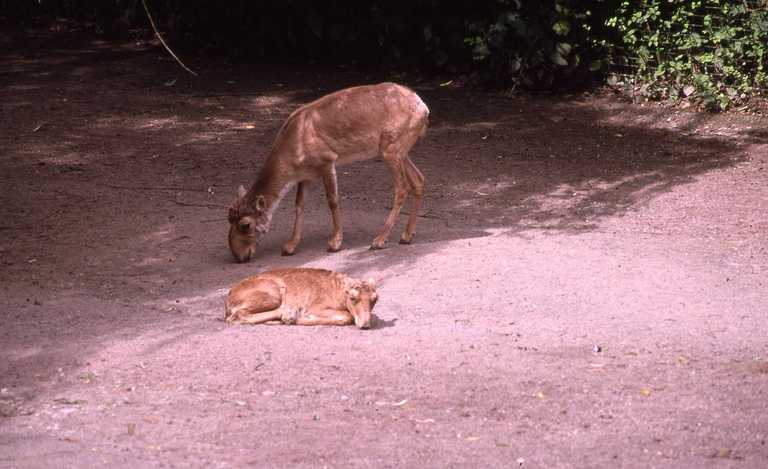
        <description>Saiga are nomadic animals and undertake seasonal migrations from summer pastures in steppe grassland to winter pastures in desert areas (8). Large groups of saiga migrate southwards to the winter grounds, covering up to 72 miles in a day (6). The rut begins in late November and males gather groups of around 30 females in 'harems', which they defend aggressively (5). During the rut, males' noses swell up and the hair tufts below the eyes are covered in a sticky secretion (2). Males do not feed much during the rutting season, when they take part in violent fights that often end in death. The male mortality rate can reach 90 percent during this time, due to exhaustion (5). Surviving males begin to migrate north at the end of April (6). Females give birth at this time, usually to two young, which are initially concealed in vegetation; all the females within the herd will give birth within a week of each other (6). Once the calves are a few days old, the whole herd breaks into smaller herds which head northwards to the summer feeding grounds (9). Once there, smaller groups break off, reforming again for the journey south the following autumn (6).&lt;/p&gt;&lt;p&gt;Saiga graze on a number of different grasses, herbs and shrubs (1). The unusual swollen nose is thought to filter out airborne dust during the dry summer migrations and to enable cold winter air to be warmed before it reaches the lungs (6).</description>
        <guid>fcc4d891a8fd19e196e9b8292937e579</guid>
        <id type="integer">2609010</id>
        <rights-holder>Wildscreen</rights-holder>
        <rights-statement>Copyright Wildscreen 2003-2008</rights-statement>
        <data-supplier-agent>ARKive</data-supplier-agent>
        <tags-hash></tags-hash>
        <attributions>
          <attribution>
            <role>Copyright</role>
            <agent>
              <acronym nil="true"></acronym>
              <display-name>Copyright Wildscreen 2003-2008. Some rights reserved</display-name>
              <homepage>http://creativecommons.org/licenses/by-nc-sa/3.0/</homepage>
              <username nil="true"></username>
            </agent>
          </attribution>
          <attribution>
            <role>Supplier</role>
            <agent>
              <acronym></acronym>
              <display-name>ARKive</display-name>
              <homepage>http://www.arkive.org/</homepage>
              <id type="integer">5978</id>
              <username>arkive</username>
            </agent>
          </attribution>
          <attribution>
            <role>Location</role>
            <agent>
              <acronym nil="true"></acronym>
              <display-name></display-name>
              <homepage nil="true"></homepage>
              <username nil="true"></username>
            </agent>
          </attribution>
          <attribution>
            <role>Source URL</role>
            <agent>
              <acronym nil="true"></acronym>
              <display-name>View original data object</display-name>
              <homepage>http://www.arkive.org/saiga-antelope/saiga-tatarica/</homepage>
              <username nil="true"></username>
            </agent>
          </attribution>
          <attribution>
            <role>Citation</role>
            <agent>
              <acronym nil="true"></acronym>
              <display-name></display-name>
              <homepage nil="true"></homepage>
              <username nil="true"></username>
            </agent>
          </attribution>
        </attributions>
        <language>English</language>
        <license>cc-by-nc-sa 3.0</license>
        <type>Text</type>
        <url>http://content10.eol.org/content_large.jpg</url>
        <medium_thumb_url>http://content1.eol.org/content_medium.jpg</medium_thumb_url>
        <small_thumb_url>http://content2.eol.org/content_small.jpg</small_thumb_url>
      </data-object>
    </data-objects>
    <nil-classes type="array"/>
  </overview>
  <table-of-contents>
    <item>
      <id>1</id>
      <label>Overview</label>
    </item>
    <item>
      <id>3</id>
      <label>Description</label>
    </item>
    <item>
      <id>290</id>
      <label>General Description</label>
    </item>
    <item>
      <id>302</id>
      <label>Nucleotide Sequences</label>
    </item>
    <item>
      <id>267</id>
      <label>Morphology</label>
    </item>
    <item>
      <id>232</id>
      <label>Reproduction and Life History</label>
    </item>
    <item>
      <id>70</id>
      <label>Behavior</label>
    </item>
    <item>
      <id>4</id>
      <label>Ecology and Distribution</label>
    </item>
    <item>
      <id>20</id>
      <label>Distribution</label>
    </item>
    <item>
      <id>41</id>
      <label>Habitat</label>
    </item>
    <item>
      <id>297</id>
      <label>Trophic Strategy</label>
    </item>
    <item>
      <id>8</id>
      <label>Conservation</label>
    </item>
    <item>
      <id>33</id>
      <label>Trends and Threats</label>
    </item>
    <item>
      <id>286</id>
      <label>Conservation Status</label>
    </item>
    <item>
      <id>6</id>
      <label>Relevance</label>
    </item>
    <item>
      <id>251</id>
      <label>Uses</label>
    </item>
    <item>
      <id>295</id>
      <label>Procedures</label>
    </item>
    <item>
      <id>300</id>
      <label>Wikipedia</label>
    </item>
    <item>
      <id>9</id>
      <label>Biodiversity Heritage Library</label>
    </item>
    <item>
      <id>7</id>
      <label>References and More Information</label>
    </item>
    <item>
      <id>17</id>
      <label>Literature References</label>
    </item>
    <item>
      <id>226</id>
      <label>Specialist Projects</label>
    </item>
    <item>
      <id>298</id>
      <label>Biomedical Terms</label>
    </item>
    <item>
      <id>227</id>
      <label>Search the Web</label>
    </item>
    <item>
      <id>13</id>
      <label>Common Names</label>
    </item>
  </table-of-contents>
  <ancestors>
    <taxon-page>
      <id type="integer">1</id>
      <canonical-form>Animalia</canonical-form>
      <iucn-conservation-status>NOT EVALUATED</iucn-conservation-status>
      <scientific-name>Animalia</scientific-name>
    </taxon-page>
    <taxon-page>
      <id type="integer">694</id>
      <canonical-form>Chordata</canonical-form>
      <iucn-conservation-status>NOT EVALUATED</iucn-conservation-status>
      <scientific-name>Chordata</scientific-name>
    </taxon-page>
    <taxon-page>
      <id type="integer">1642</id>
      <canonical-form>Mammalia</canonical-form>
      <iucn-conservation-status>NOT EVALUATED</iucn-conservation-status>
      <scientific-name>Mammalia</scientific-name>
    </taxon-page>
    <taxon-page>
      <id type="integer">7678</id>
      <canonical-form>Artiodactyla</canonical-form>
      <iucn-conservation-status>NOT EVALUATED</iucn-conservation-status>
      <scientific-name>Artiodactyla</scientific-name>
    </taxon-page>
    <taxon-page>
      <id type="integer">7687</id>
      <canonical-form>Bovidae</canonical-form>
      <iucn-conservation-status>NOT EVALUATED</iucn-conservation-status>
      <scientific-name>Bovidae</scientific-name>
    </taxon-page>
    <taxon-page>
      <id type="integer">103528</id>
      <canonical-form>Saiga</canonical-form>
      <iucn-conservation-status>NOT EVALUATED</iucn-conservation-status>
      <scientific-name>Saiga</scientific-name>
    </taxon-page>
    <taxon-page>
      <id type="integer">1038782</id>
      <canonical-form>Saiga tatarica</canonical-form>
      <iucn-conservation-status>Critically Endangered (CR)</iucn-conservation-status>
      <scientific-name>&lt;i&gt;Saiga tatarica&lt;/i&gt; (Linnaeus, 1766)</scientific-name>
    </taxon-page>
  </ancestors>
  <children>
  </children>
  <curators>
    <user>
      <credentials>Portland State University, MA Education

</credentials>
      <id type="integer">7</id>
      <username>klans</username>
    </user>
    <user>
      <credentials>BA Physics - Johns Hopkins University
MS Education - Johns Hopkins University
ME Engineering Physics - University of Virginia


</credentials>
      <id type="integer">10</id>
      <username>peter</username>
    </user>
    <user>
      <credentials>Ph.D., University of Bristol (1976)
D.Sc., Queen's University, Belfast (1990)
</credentials>
      <id type="integer">11</id>
      <username>paddy</username>
    </user>
    <user>
      <credentials>developer</credentials>
      <id type="integer">13</id>
      <username>pleary</username>
    </user>
    <user>
      <credentials></credentials>
      <id type="integer">11793</id>
      <username>wilsond</username>
    </user>
    <user>
      <credentials>Asst. Project Manager, Antarctic Invertebrates, Smithsonian Institution
Visiting Scientist, Chemicals Affecting Insect Behavior Lab, US Agricultural Research Service, 2005-2006
Hammock, J., Vinyard, B., Dickens, J. 2007. Response to host plant odors and aggregation pheromone by larvae of the Colorado potato beetle on a servosphere.  Arthropod-Plant Interactions, 1(1):27-35
PhD, Biological Oceanography, Massachussetts Institute of Technology/Woods Hole Oceangraphic Institution, 2005</credentials>
      <id type="integer">20470</id>
      <username>jhammock</username>
    </user>
    <user>
      <credentials>University of Michigan, PhD 1997
Thesis: Social behavior and vocal communication of American Crows (Corvus brachyrhynchos)

Member of Ecological Society of America, Entomological Society of America.</credentials>
      <id type="integer">25567</id>
      <username>csparr</username>
    </user>
    <user>
      <credentials></credentials>
      <id type="integer">33422</id>
      <username>mstuder</username>
    </user>
    <user>
      <credentials>Curator of Zoology (Fishes), Field Museum of Natural History</credentials>
      <id type="integer">34360</id>
      <username>mwestneat</username>
    </user>
    <user>
      <credentials>EOL Species Pages Coordinator, Ph. D. in Entomology, University of Arizona 1999, Diploma in Biology, Freie Universit&#228;t Berlin 1989</credentials>
      <id type="integer">35200</id>
      <username>Katja</username>
    </user>
    <user>
      <credentials>William Miller, PhD
Assistant Professor
Baker University
Dept. of Biology
PO Box 65
Baldwin city, Kansas 
66006-0065


</credentials>
      <id type="integer">35243</id>
      <username>WMiller</username>
    </user>
    <user>
      <credentials>University of California Berkeley
</credentials>
      <id type="integer">35508</id>
      <username>tuco</username>
    </user>
    <user>
      <credentials></credentials>
      <id type="integer">36197</id>
      <username>MarthaTestuser</username>
    </user>
    <user>
      <credentials>B.A. Zoology, M.S. Embryology/physiology
college faculty for 44 years
member HAPS (Human Anatomy and Physiology Society)</credentials>
      <id type="integer">36558</id>
      <username>judyjunkyard</username>
    </user>
    <user>
      <credentials>Active Member of Wildlife society of Africa, herpetological society of southern Africa and general manager and curator of reptile research and information center (Zebra Country lodge, Cullinan district Pretoria)</credentials>
      <id type="integer">37046</id>
      <username>Vaughan</username>
    </user>
    <user>
      <credentials>Scientist National Institutes of Health</credentials>
      <id type="integer">38259</id>
      <username>saimiri</username>
    </user>
    <user>
      <credentials>faculty, Department of Biology
University of Miami
Coral Gables, Fl 33124

AAAS, ICRS, Sigma Xi

http://www.bio.miami.edu/Fac/Sealey.html</credentials>
      <id type="integer">38707</id>
      <username>ksealey</username>
    </user>
    <user>
      <credentials>Associate Professor of Biology, Curator of Mammals and Birds, University of Wisconsin - Stevens Point

Yahnke CJ, 2006. Habitat use and natural history of small mammals in the Paraguayan chaco. Mastozoologia Neotropical, 13(1);103-116.

Yahnke CJ, 2006. Testing optimal foraging theory using bird predation on goldenrod galls. American Biology Teacher, 68(8):471-475.

Yahnke CJ, PL Meserve, TG Ksiazek, and JN Mills. 2001. Patterns of infection with Laguna Negra virus in wild populations of Calomys laucha in the central Paraguayan chaco.  American Journal of Tropical Medicine and Hygiene, 65(6):768-776.

Yahnke CJ, I Gamarra de Fox, and F Colman. 1998. Mammalian species richness in Paraguay: the effectiveness of national parks in preserving biodiversity.  Biological Conservation 84:263-268.

Yahnke CJ, J Unger, BA Lohr, DA Meritt, and W Heuschele. 1997.  Age specific fecundity, litter size, and sex ratio in the chacoan peccary (Catagonus wagneri).  Zoo Biology 16:301-307.

Yahnke, CJ, WE Johnson, E Geffen, D Smith, F Hertel, MS Roy, CF Bonacic, TK Fuller, B Van Valkenburgh, and RK Wayne. 1996. Darwin&#8217;s fox: a distinct endangered species in a vanishing habitat.  Conservation Biology 10:366-375.

Yahnke CJ. 1995.  Metachromism and the insight of Wilfred Osgood: evidence of common ancestry for Darwin&#8217;s fox and the Sechura fox.  Revista Chilena de Historia Natural 68:459-467

American Society of Mammalogists
National Association of Biology Teachers
Sigma XI
</credentials>
      <id type="integer">39446</id>
      <username>cyahnke</username>
    </user>
    <user>
      <credentials>Emeritus Fellow, Trinity College Dublin

Holdich, Catherine, David M., Noel, Pierre Y., Reynolds, Julian D. and Haffner, Patrick (eds) (2006). Atlas of crayfish in Europe. Museum national d'Histoire naturelle, Paris, 187 pages. Patrimoines naturels, 64.

Hudson, Anne V. and Reynolds, Julian D. (1984). Distribution of Irish intertidal Talitridae. Bulletin of the Irish biogeographical Society, 8, 63-76.

Reynolds, Julian D. (1976). Occurrence of the fresh-water Bryozoan, Cristatella mucedo Cuvier, in British Columbia. Syesis, 9, 365-366.

Smyth, Thomas and Reynolds, Julian D.  (1995). Survival ability of statoblasts of freshwater Bryozoa found in Renvyle Lough, County Galway.  Biology and Environment: Proceedings of the Royal Irish Academy 95B (1), 65-68.

Wickenberg, Maria and Reynolds, Julian D. (2002). A recent Irish record of the woodlouse  Acaeroplastes melanurus (Budde-Lund, 1885) (Isopoda: Porcellionidae), considered to be extinct in the British Isles.  Bulletin of the Irish Biogeographical Society, 26, 60-63.</credentials>
      <id type="integer">39544</id>
      <username>jrynolds</username>
    </user>
    <user>
      <credentials>Affiliated with EOL Species Pages Group</credentials>
      <id type="integer">39552</id>
      <username>lshapiro</username>
    </user>
    <user>
      <credentials>Staff in a natural history museum
Member of a professional society (SECEM)</credentials>
      <id type="integer">39803</id>
      <username>eliadelom</username>
    </user>
    <user>
      <credentials>Curator of marine invertebrates, National Museums Northern Ireland (Ulster Museum)
Author Sponges of the British Isles - A colour guide and working document, 1992 Edition. Ackers, R.G., Moss, D. &amp; Picton, B. E. 1992. Marine Conservation Society, UK. Revised and extended, 2007, Bernard Picton, Christine Morrow &amp; Rob van Soest. PDf and website</credentials>
      <id type="integer">40160</id>
      <username>BernardPicton</username>
    </user>
  </curators>
  <comments>
    <count>0</count>
  </comments>
  <images>
    <count>4</count>
  </images>
  <videos>
    <count>0</count>
  </videos>
</taxon-page>