Poa palustris L.

Fowl bluegrass


Species recognized by The Integrated Taxonomic Information System external link, T Orrell (custodian) in 
IUCN Red List Status: NOT EVALUATED external link Showing: scientific names

Media Center Navigation


Poa palustris L.

Images


Choose images

Poa-palustris
Poa-palustris
Poa-palustris
Poa-palustris
Poa-palustris
Poa-palustris
Poa-palustris
Poa-palustris
Poa-palustris

Page navigation

Page 1 Next


Classification : Text | Graphic |

General Description

Description

Source and Additional Information
Project
Editor
S. I. Ali & M. Qaiser
Location
Citation
Flora of Pakistan Vol. 0: 415 in eFloras.org, Missouri Botanical Garden. Accessed Nov 12, 2008.

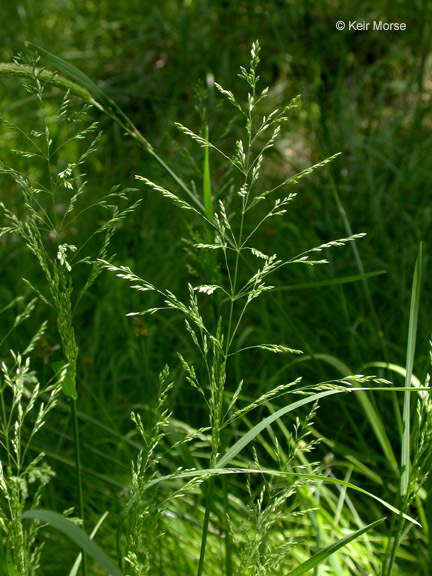
Loosely tufted short-lived perennial; culms (15-)40-80(-150)cm high, erect or spreading, sometimes geniculate at the base. Leaf-blades flat, 5-20cm long, 1-2(-4)mm wide, flaccid, gradually tapering to a stout point, scaberulous on the margins and both surfaces; ligule rounded, 1-3mm long. Panicle narrowly pyramidal 10-20(-30)cm long, spreading; branches mostly in distant clusters of 3-6, scabrid. Spikelets 2-5-flowered, ovate to oblong, 3-5mm long, yellowish-green or purplish; glumes lanceolate to narrowly ovate, the lower 2-3 mm long, 1-3-nerved, the upper broader, 2.5-3 mm long, 3-nerved; lemmas narrowly oblong in side-view, 2.5-3 mm long, obtuse, ciliate on the keel and marginal nerves, with sparse wool at the base; palea almost as long as the lemma, scabrid along the keels; anthers 1.3-1.5 long.
References

Comments

Source and Additional Information
Project
Editor
S. I. Ali & M. Qaiser
Location
Citation
Flora of Pakistan Vol. 0: 415 in eFloras.org, Missouri Botanical Garden. Accessed Nov 12, 2008.

Swamp Meadow-grass is distinguished from Poa nemoralis by its longer ligules, from Poa trivialis by its smooth leaf-sheaths and blunt ligules, and from Poa pratensis by its longer ligules and the absence of rhizomes.
References

Comments

Source and Additional Information
Project
Editor
Wu Zhengyi, Peter H. Raven & Hong Deyuan
Location
Citation
Flora of China Vol. 22: 296, 299, 300, 301, 302, 303, 304 in eFloras.org, Missouri Botanical Garden. Accessed Nov 12, 2008.

Poa palustris, like P. nemoralis, is one of the most complicated and polymorphic species. Hybridization with P. nemoralis, coupled with apomixis, has formed a series of morphologically and genetically distinct populations treated here as P. lapponica.

Despite its great polymorphism, Poa palustris has not been divided satisfactorily into stable taxa. Its distribution in China seems to be quite restricted, limited to the northern regions only. It is probably naturalized in central and southern areas. In the mountains of the south and southwest it is replaced by the allied species P. faberi. In E China, Japan, and Korea it is very close to, and probably replaced by, a third, related species, P. sphondylodes. Unusual plants in Anhui differ by the glumes and lemma being much narrower with a prominent vein. Some populations of P. palustris in N China and even in the Russian Far East differ from normal P. palustris by the appearance of characters of P. sphondylodes: ligule longer than 3–4 mm, upper node infrequently only to 1/3 way up culm, leaf blades soft and flat, panicle branches sometimes very short, spikelets crowded at very base of branches, and longest branches at 2nd node of panicle. Both Ohwi (Fl. Jap. 164. 1965) and Koyama (Grasses Japan Neighboring Regions, 96. 1987) reported P. palustris with a ligule to 5 mm from Japan; similarly Chung (Korean Grass. 71. 1965) and Lee (Man. Korean Grass. 154. 1966) from Korea. Poa palustris with such long ligules occurs in the Pacific area only, and these plants might be closer to P. sphondylodes. Such plants may also be found in coastal areas of China.

Description

Source and Additional Information
Project
Editor
Wu Zhengyi, Peter H. Raven & Hong Deyuan
Location
Citation
Flora of China Vol. 22: 296, 299, 300, 301, 302, 303, 304 in eFloras.org, Missouri Botanical Garden. Accessed Nov 12, 2008.

Culms loosely tufted, 40–80(–120) cm tall, erect or slightly geniculate, rarely branching near base; nodes 5 or 6, uppermost at or above middle of culm. Shoots extravaginal. Leaf sheath smooth or rarely scabrid; equal to or shorter than blade; blade flat, 8–20 cm × 2–3(–5) mm; ligule 2–3 mm. Panicle slightly contracted, 10–20(–30) cm; branches obliquely ascending, 3–8 per node, basal primary branch 1/2–2/3 as long as panicle with spikelets in distal 1/2. Spikelets ovate-oblong, yellowish green, 2.5–5(–7) mm, florets (2–)3–5(–7); rachilla scabrid or warty, rarely smooth; glumes almost equal, 2–3.5(–4) mm; lemma 3–3.5(–4) mm, keel shortly villous for 1/2 of length, marginal veins for 1/3, apex golden or rarely silvery, membranous; callus webbed; palea keel scabrid, area between keels smooth and glabrous. Anthers 1.2–1.5(–2) mm. Fl. Jun–Jul. 2n = 28, 30, 32, 42.
"Poa palustris L.". Encyclopedia of Life, available from "http://www.eol.org/pages/1114031". Accessed 19 Mar 2010.