Macaca nigra (Desmarest, 1822)

Celebes Black "Ape"


Species recognized by The Integrated Taxonomic Information System external link, T Orrell (custodian) in 
IUCN Red List Status: Critically Endangered (CR) external link Showing: scientific names

Media Center Navigation


Macaca nigra (Desmarest, 1822)

Images


Items in yellow are not reviewed.

Choose images

Macaca nigra
Macaca nigra

Page navigation


Classification:

Overview

Biology

Source and Additional Information
Supplier
Attribution
Copyright Wildscreen 2003-2008
Indexed
May 05, 2010

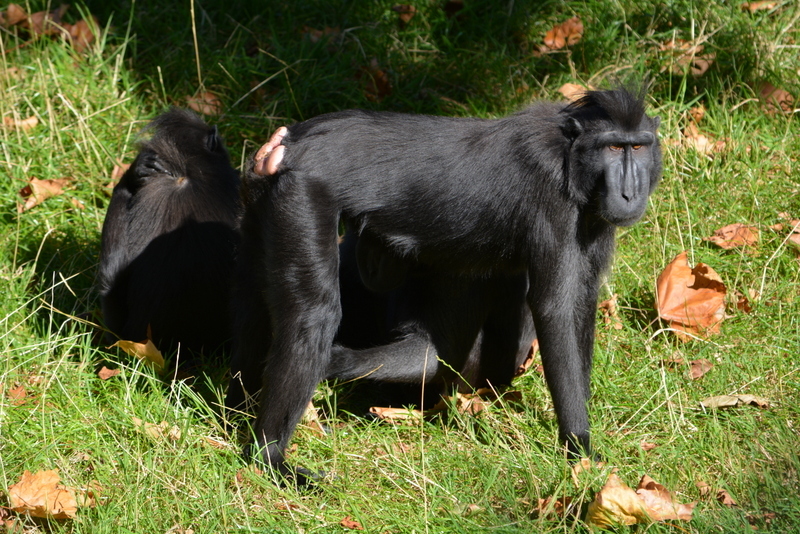
Crested black macaques are social monkeys and, before their decline in the wild, were often seen in groups of up to 100 individuals (5). At present they are found in smaller groups. During the day they split into smaller units of 10 to 25 individuals, led by dominant males who police the group and prevent serious fights developing. They feed on figs, other fruit, vegetation, insects and small animals such as mice, crabs and lizards (6). Sometimes food is not eaten immediately but is stored in cheek pouches for a while. Individuals in the group maintain relationships by grooming each other and communicating vocally with grunts (4). Adult males 'yawn' to display their large canine teeth in order to assert dominance and avoid conflict (5). Breeding is non-seasonal and therefore occurs at any time of year. Females come into oestrous every 33 to 36 days and advertise their fertility with swollen pink bottoms. The females are monopolised by the group's dominant male, and after a gestation period of five and a half months a single infant is born (5). The offspring reach sexual maturity at four to six years and may live for up to 25 years (5).
Katja Schulz. Editor. "Macaca nigra (Desmarest, 1822)". Encyclopedia of Life, available from "http://www.eol.org/pages/323954". Accessed 30 Jul 2010.