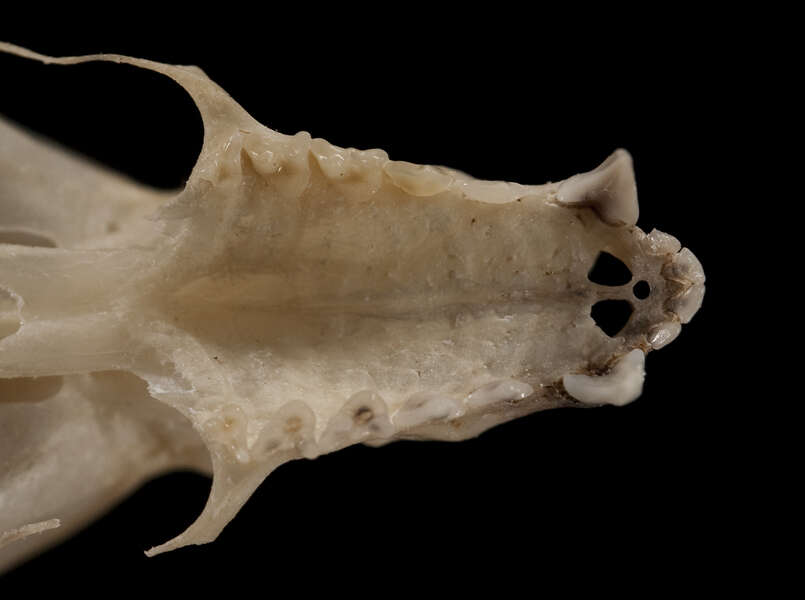
Glossophaga soricina (Pallas, 1766)

Pallas' Long-tongued Bat


Species recognized by The Integrated Taxonomic Information System external link, T Orrell (custodian) in 
IUCN Red List Status: Least Concern (LC) external link Showing: scientific names

Media Center Navigation


Classification : Text | Graphic |

General Description

Wing overcomes resistance: Pallas's long-tongued bat

Source and Additional Information
Supplier
Editor
The Biomimicry Institute


The wing of Pallas's long-tongued bat overcomes the continuous resistance on its membrane by flipping its outer edge upside down and then quickly back up during the upstroke.

     
  "On the downstroke of a bird's wing during slow flight, for instance, the primary feathers form a solid plane that pushes downward and backward on the air, propelling the bird upward and forward. On the upstroke, the primaries separate, and much of the air that would push the bird back down rushes through the gaps instead. The wing of a bat, however, is a membrane that offers continuous resistance. What happens during its upstroke?

Anders Hedenström of Lund University in Sweden and his colleagues studied vortices in the wake of the Pallas's long-tongued bat, Glossophaga soricina, in the fog-filled air of a wind tunnel. At slow speeds, they discovered, both the downstroke and the upstroke push the animal up and forward. To move the bat forward and upward during the upstroke, the outer part of the wing flips upside down and flicks quickly backward. (At high speeds, the wing doesn't flip and part of it does push the bat down during the upstroke, but that resistance is at least partly compensated for by continuous lift on the front of the wing at the higher speed.)

Whether the flip-flop is common to all bats or an adaptation special to the ones that hover—such as G. soricina, a nectar-eater—remains to be seen. (Science)" (Reebs 2007)


"The flapping flight of animals generates an aerodynamic footprint as a time-varying vortex wake in which the rate of momentum change represents the aerodynamic force. We showed that the wakes of a small bat species differ from those of birds in some important respects. In our bats, each wing generated its own vortex loop. Also, at moderate and high flight speeds, the circulation on the outer (hand) wing and the arm wing differed in sign during the upstroke, resulting in negative lift on the hand wing and positive lift on the arm wing. Our interpretations of the unsteady aerodynamic performance and function of membranous-winged, flapping flight should change modeling strategies for the study of equivalent natural and engineered flying devices." (Hedenström 2007:894)

Watch Videos
  Learn more about this functional adaptation.
References
  • Stéphan Reebs. 2007. Flip-Flop Flap. Natural History: Samplings--News from Nature http://www.naturalhistorymag.com/index_samplings.html, Accessed 9/18/2007.
  • Hedenström, A.; Johansson, L.C.; Wolf, M.; von Busse, R.; Winter, Y.; Spedding, G.R. 2007. Bat flight generates complex aerodynamic tracks. Science. 316: 894-897.
  • Johansson, L.C.; Wolf, M.; von Busse, R.; Winter, Y.; Spedding, G.R.; Hedenström, A. 2008. The near and far wake of Pallas’ long tongued bat (Glossophaga soricina). J. Exp. Biol. 211: 2909-2918.
  • Muijres, F.; Johansson, C.J.; Barfield, R.; Wolf, M.; Spedding, G.R.; Hedenström, A. 2008. Leading edge vortex improves lift in slow-flying bats. Science. 319: 1250-1253.
"Glossophaga soricina (Pallas, 1766)". Encyclopedia of Life, available from "http://www.eol.org/pages/327431". Accessed 21 Mar 2010.