Orycteropus afer (Pallas, 1766)
Aardvark
Species recognized by The Integrated Taxonomic Information System
, T Orrell (custodian) in
-
Animalia +
-
Chordata +
-
Mammalia +
-
Tubulidentata +
-
Orycteropodidae +
-
Orycteropus +
-
Orycteropus afer (Pallas, 1766)
- Orycteropus afer afer (Pallas, 1766) +
- Orycteropus afer adametzi Grote, 1921 +
- Orycteropus afer aethiopicus Sundevall, 1843 +
- Orycteropus afer angolensis Zukowsky and Haltenorth, 1957 +
- Orycteropus afer erikssoni Lönnberg, 1906 +
- Orycteropus afer faradjius Hatt, 1932 +
- Orycteropus afer haussanus Matschie, 1900 +
- Orycteropus afer kordofanicus Rothschild, 1927 +
- Orycteropus afer lademanni Grote, 1911 +
- Orycteropus afer leptodon Hirst, 1906 +
- Orycteropus afer matschiei Grote, 1921 +
- Orycteropus afer observandus Grote, 1921 +
- Orycteropus afer ruvanensis Grote, 1921 +
- Orycteropus afer senegalensis Lesson, 1840 +
- Orycteropus afer somalicus Lydekker, 1908 +
- Orycteropus afer wardi Lydekker, 1908 +
- Orycteropus afer wertheri Matschie, 1898 +
-
Orycteropus afer (Pallas, 1766)
-
Orycteropus +
-
Orycteropodidae +
-
Tubulidentata +
-
Mammalia +
-
Chordata +
-
Archaea +
-
Bacteria +
-
Chromista +
-
Fungi +
-
Plantae +
-
Protozoa +
-
Viruses +
Table of Contents
-
-
-
-
-
-
-
-
-
-
-
-
-
-
-
-
-
-
-
-
-
-
-
-
-
-
- Add New Content
Overview
Biology
Source and Additional Information
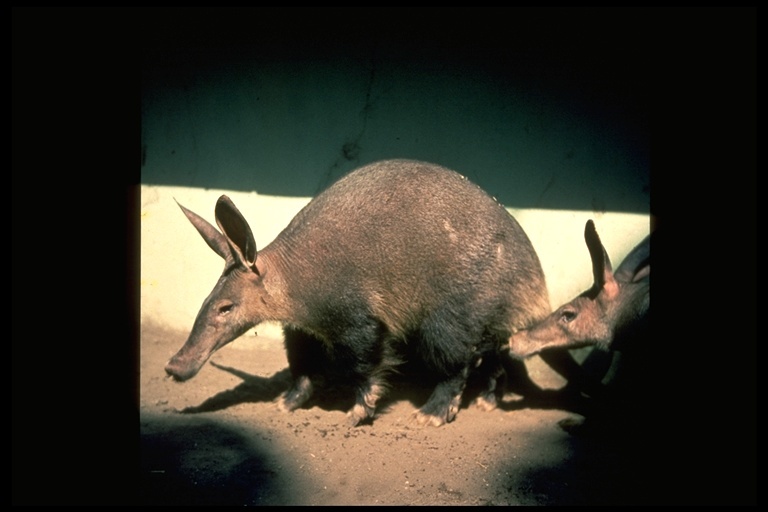
The elusive aardvark is primarily a nocturnal animal (1), spending the day curled up in its burrow asleep (5). However, it can occasionally be spotted venturing outside in the daylight on a cold afternoon (1), or early in the morning when it may sun itself by the burrow's entrance (5). At night the aardvark leaves the safety of its burrow and begins its search for food (5). It feeds almost exclusively on a smorgasbord of ant and termite species (3), and will forage for its meal by travelling in a zigzag path, inspecting a strip of ground about 30 metres wide with its snout (5). The aardvark tends to walk on its claws, somewhat slowly and awkwardly, and on soft ground its dragging tail leaves a trail behind (5). Once the aardvark has located its food, either after digging into the ground, tearing into a termite nest, or finding an army of ants on the march (5), the aardvark gathers its prey with its long, sticky tongue, which can extend to a remarkable 30 centimetres (5). It does not chew its insect prey, of which it can eat over 50,000 each night, but instead swallows it whole and grinds it up in a muscular area of its lower stomach (3). Digging is a central feature of the aardvark's life, and an activity that it is incredibly adept at. Not only does it dig shallow holes in search of food, it also digs burrows, measuring up to three metres long (5), for daytime rest and to escape predators (1), and also excavates extensive tunnel systems in which it gives birth to its young. These may be up to 13 metres long, with numerous chambers and multiple entrances (5). Its powerful limbs and sharp, spoon-shaped claws make easy work of digging (3), even in hard, stone-baked ground, and it can dig a hole faster than several men with shovels (5). The burrows of the aardvark are used by numerous other African animals, from invertebrates to mammals, making the aardvark an important species in the ecosystems in which it is found (1). The aardvark is a largely solitary animal and is only occasionally seen in the company of other individuals (1), presumably for mating and when a young accompanies its mother (5). The gestation period in this species lasts for between seven and nine months, resulting in the birth of a single, naked, flesh-coloured young. The young aardvark will remain in the burrow for about two weeks before starting to accompany its mother on night time foraging trips. By the age of six months, the young can dig for itself, and by 12 months it has reached the size of an adult. Sexual maturity is obtained at about two years of age (5).
"Orycteropus afer (Pallas, 1766)". Encyclopedia of Life, available from "http://www.eol.org/pages/327830". Accessed
21 Mar 2010.

Retrieving comments, please wait...


Retrieving comments, please wait...