Tapirus terrestris (Linnaeus, 1758)

Brazilian Tapir


Species recognized by The Integrated Taxonomic Information System external link, T Orrell (custodian) in 
IUCN Red List Status: Vulnerable (VU) external link Showing: scientific names

Media Center Navigation


Tapirus terrestris (Linnaeus, 1758)

Images


Items in yellow are not reviewed.

Choose images

Tapirus terrestris
Tapirus terrestris
Tapirus terrestris (Linnaeus, 1758)

Page navigation

Page 1 Next


Classification : Text | Graphic |

Overview

Biology

Source and Additional Information
Supplier

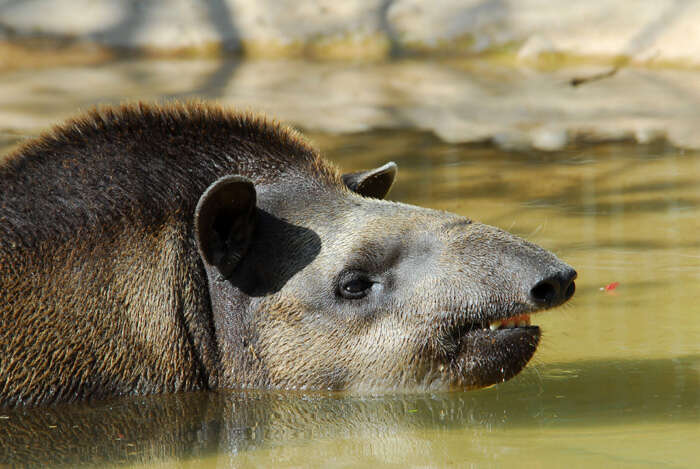
During the day lowland tapirs remain hidden in thick cover, emerging only at night to browse on leaves of small plants, shrubs, lianas and saplings of trees, as well as tree bark, reeds and fruits (2) (4). Well worn tracks are followed throughout the home range to food and water sources (3). This tapir swims well and spends much of its time wallowing in water, which helps to get rid of skin parasites (3) in addition to providing protection from terrestrial predators such as jaguars and pumas (2). Tapirs will also regularly walk on river beds, searching for favoured aquatic plants (6). These tapirs are primarily solitary animals, except during the mating season (6). Females give birth to a single calf after a gestation period of 13 months (8), which then remains in intermittent contact with its mother for around seven months, becoming increasingly independent (4) (6). Lowland tapirs have been known to live up to 35 years in captivity (3).
Katja Schulz. Editor. "Tapirus terrestris (Linnaeus, 1758)". Encyclopedia of Life, available from "http://www.eol.org/pages/328009". Accessed 21 Mar 2010.