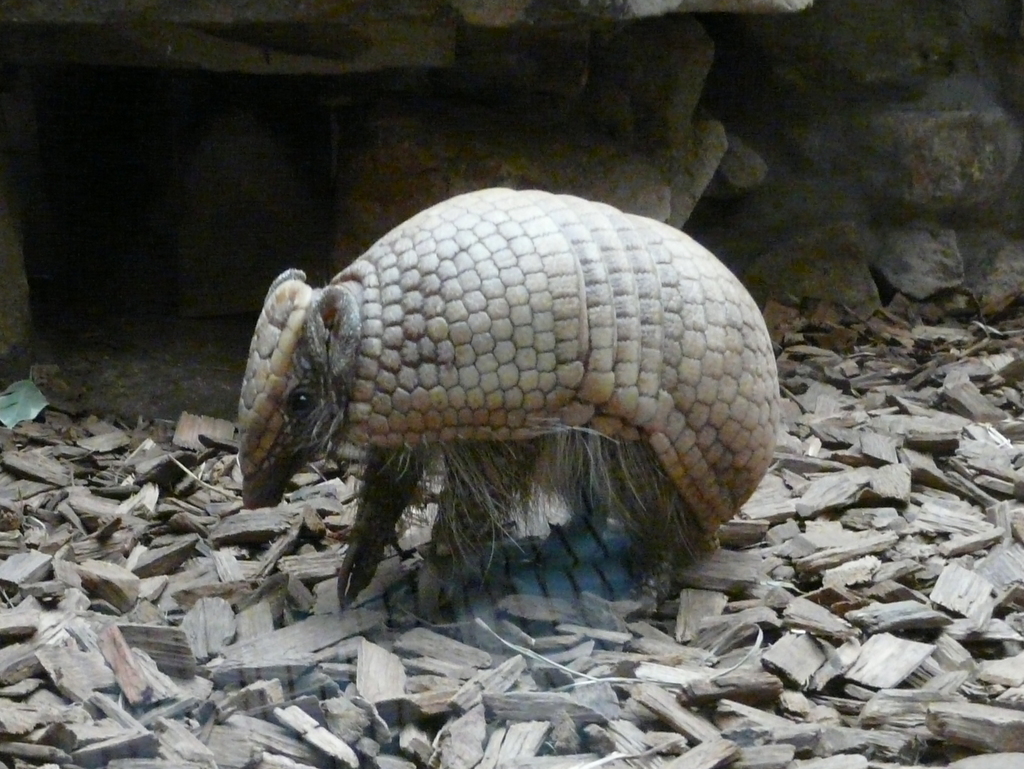
Tolypeutes matacus (Desmarest, 1804)

Southern three-banded armadillo


Species recognized by The Integrated Taxonomic Information System external link, T Orrell (custodian) in 
IUCN Red List Status: Near Threatened (NT) external link Showing: scientific names

Media Center Navigation


Classification : Text | Graphic |

Overview

Biology

Source and Additional Information
Supplier
Location
Citation

Unlike other armadillo species, the southern three-banded armadillo does not dig burrows, and instead takes refuge in the abandoned burrows of other animals such as anteaters (3) (4). While generally a solitary species, as many as twelve southern three-banded armadillos have been found sharing a burrow during the winter (3). This species has a broad diet, comprising of a variety of invertebrates, particularly beetle larvae, which are taken throughout the year, along with large quantities of ants and termites during the dry season (July to November), and fruits during the summer rains (5). When foraging for ants and termites, this species will probe the ground with its snout, prise off tree bark, or tear into nests with its powerful claws. A remarkably fast mover, when threatened the southern three-banded armadillo escapes by running on its hind-legs, with its foreclaws touching the ground (3).

Breeding is believed to occur between October and January (4), with most births in Paraguay occurring between November and January (3). After a gestation period of 120 days, the female gives birth to a single young, which is suckled for a further 10 weeks (2) (4). The southern three-banded armadillo reaches sexual maturity at around 9 to 12 months old, and has been known to live for over 17 years in captivity (3).

"Tolypeutes matacus (Desmarest, 1804)". Encyclopedia of Life, available from "http://www.eol.org/pages/328498". Accessed 16 Mar 2010.