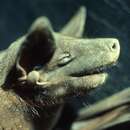
Cheiromeles torquatus Horsfield, 1824

Hairless bat


Species recognized by The Integrated Taxonomic Information System external link, T Orrell (custodian) in 
IUCN Red List Status: Least Concern (LC) external link Showing: scientific names

Media Center Navigation


Classification : Text | Graphic |

Morphology

Physical Description

Source and Additional Information
Author
Paul Thomson, University of Michigan
Editor
Ondrej Podlaha, University of Michigan
Citation
Thomson, P. 2002. "Cheiromeles torquatus" (On-line), Animal Diversity Web. Accessed October 25, 2009 at http://animaldiversity.ummz.umich.edu/site/accounts/information/Cheiromeles_torquatus.html. 


The naked bat is a striking member of the Molossidae. It is virtually hairless, except for short, fine hairs on the head and tail membrane, and black, bristly hairs around the neck, on the first toe of the hind foot (probably used for grooming) and on the throat sack, which produces a strong-smelling secretion. Males secrete the substance by a series of small pores, females by a single large orifice (Lekagul and McNeely, 1977). Both sexes also possess a pouch along the sides of the body, formed by a fold of skin that runs from the upper arm to the upper part of the leg. The pouches open towards the rear and the wings are pushed into them by the hind feet. In this way, the bat can move about relatively freely on all four limbs. Cheiromeles torquatus has the thickest jaws, widest face, and some of the broadest-tipped wings in the entire family. The head is relatively large and broad with a well-developed posterior sagittal crest. Unlike most Molossidae, the ears are separate, small and triangular, and the lips are smooth. The muzzle lacks a noseleaf and the snout projects well beyond the bottom jaw. The thick, elastic skin is almost black and contains many wrinkles and folds. The thick tail protrudes well over half its length. The wings are attached to the midpoint of the back. The first toe of each hind foot is opposable and equipped with a flattened nail rather than a claw. The dental formula is 1/1, 1/1, 1/2, 3/3 x 2 = 26. The upper incisors are robust, short and protrude forward. There is a diastema between the upper incisor and canine (Lekagul and McNeely, 1977). Head and body: 132-145 mm; tail: 56-71 mm. Weight: 167-196 grams.

 
"Cheiromeles torquatus Horsfield, 1824". Encyclopedia of Life, available from "http://www.eol.org/pages/328861". Accessed 21 Mar 2010.