Levisticum officinale W. D. J. Koch

Garden lovage


Species recognized by The Integrated Taxonomic Information System external link, T Orrell (custodian) in 
IUCN Red List Status: NOT EVALUATED external link Showing: scientific names

Media Center Navigation


Levisticum officinale W. D. J. Koch

Images


Choose images

Levisticum-officinale

Page navigation

Page 1 Next


Classification : Text | Graphic |

General Description

Description

Source and Additional Information
Project
Editor
Wu Zhengyi, Peter H. Raven & Hong Deyuan
Location
Citation
Flora of China Vol. 14: 172 in eFloras.org, Missouri Botanical Garden. Accessed Nov 12, 2008.

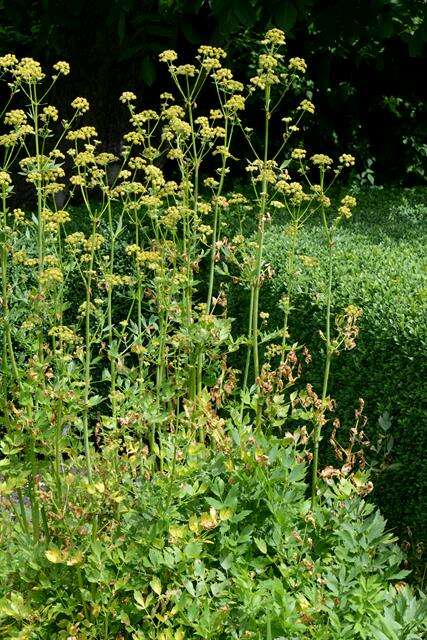
Plants 1–2.5 m, aromatic. Rhizome stout, 4–5 cm thick. Stem purplish green, lower branches alternate, upper branches opposite or whorled. Basal and lower leaves long-petiolate, sheaths purple-red; blade broadly-triangular-ovate, 2–3-pinnate, pinnae all petiolulate; ultimate segments obovate or rhombic-ovate, 4–11 × 2–7 cm, 2–3-lobed, with a few coarse teeth. Umbels ca. 12 cm across; bracts 7–11, lanceolate, reflexed, scabrous, white-scarious-margined; rays 12–20, subequal; bracteoles 8–11, similar to bracts. Fruit brown, 5–7 × 3–4 mm. Fl. Jun–Aug, fr. Aug–Sep. n = 11.

Comments

Source and Additional Information
Project
Editor
Wu Zhengyi, Peter H. Raven & Hong Deyuan
Location
Citation
Flora of China Vol. 14: 172 in eFloras.org, Missouri Botanical Garden. Accessed Nov 12, 2008.

This species was introduced to China in 1957. It is used as a substitute for the traditional Chinese medicine “dang gui” (see Angelica sinensis) and for flavoring. The young shoots and leaves can be eaten as a vegetable.
"Levisticum officinale W. D. J. Koch". Encyclopedia of Life, available from "http://www.eol.org/pages/467097". Accessed 21 Mar 2010.