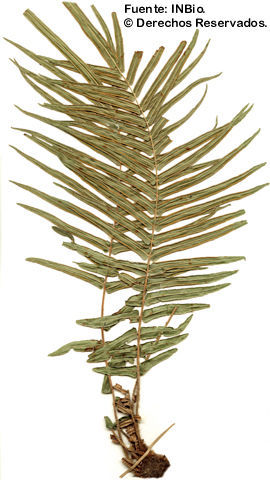
Pteris vittata (Chinese Brake) is a species of perennialherb in the family Pteridaceae. They have pinnate leaves. They have alternation of generations.
Definition: Of plant duration, a plant whose life span extends over more than two growing seasons, c.f. annual, biennial, ephemeral, of flowering with respect to architecture, hapaxanthic, monocarpic, pleonanthic
Definition: Determined for type of life cycle being annual, biennial, perennial etc.
Comment: The life cycle habit indicates the typical duration of an individual plant's life. Common values are annual, biennial, and perennial. Some plants have different durations depending on environment or location, so a plant can have more than one value.
Definition: Of plant duration, a plant whose life span extends over more than two growing seasons, c.f. annual, biennial, ephemeral, of flowering with respect to architecture, hapaxanthic, monocarpic, pleonanthic
Definition: This organism produces this material or substance, either during its life or after death. A produces B if some process that occurs in A has output B.
Definition: The important feature of homospory is the four fold division involved in spore production, this takes the form of either a tetrahedra which gives a trilete (Y shaped scar) spore or a tetragon which gives a monolete (single linear scar) spore.
Definition: A group of species that exploit the same food resources, and/or use the same feeding or foraging methods. http://en.wikipedia.org/wiki/Guild_(ecology)